What's My Occupation? How to Answer Based on Your Work, Role, or Situation
If you are filling out a form, updating a profile, or answering a question like "what's my occupation?", the simplest answer is usually the kind of work you do, not the company name on your uniform. Your occupation is the broader work category that best describes your role: warehouse associate, retail salesperson, cashier, food service worker, restaurant server, student, homemaker, unemployed, or retired. It can be more general than your exact job title and more practical than your long-term career plan. If you are also trying to understand what kind of work fits your interests, a structured career interest tool such as a career interest assessment for exploration can help you connect your current role with possible future directions.

What Does Occupation Mean?
Occupation means the type of work a person does or the category of work they are associated with. It answers the broad question "What kind of work do you do?" A job is usually more specific. For example, "night stocker at a supermarket" is a job title, while "stock clerk," "retail worker," or "inventory associate" may be the occupation.
Career is broader again. It describes your overall path over time, including jobs, training, education, skills, and transitions. Profession often refers to work that requires specialized education, licensing, or formal standards, such as lawyer, nurse, engineer, or accountant. In everyday forms, though, the person asking for your occupation usually wants a plain answer that groups your work in a recognizable way.
So if you are wondering "what's my occupation meaning?", think in three layers:
- Your employer is where you work.
- Your job title is the specific position you hold.
- Your occupation is the broader work category your duties fit into.
This matters because many applications, surveys, and career tools do not need every detail of your employer or schedule. They need a useful label for the kind of work you do.
How to Choose the Right Occupation Answer
The safest way to choose your occupation is to describe your main duties first, then translate those duties into a familiar work category. Ask yourself what you spend most of your working time doing. Do you handle customers, move inventory, prepare food, drive, clean, supervise, repair, teach, analyze data, sell products, or manage records?
Then choose the occupation label that best matches those duties. If your official job title is unusual, use a clearer label on general forms. For example, "fulfillment team member" may become "warehouse associate" if you pick items, pack orders, and move stock. "Crew member" may become "fast food worker" if you take orders, prepare food, clean stations, and support service flow.

Use the most honest and specific label that still makes sense to a stranger. "Worker" is usually too vague. "Amazon worker" or "Walmart employee" may be too employer-specific. "Warehouse associate," "retail sales associate," "cashier," "stock clerk," "customer service representative," or "fast food crew member" is usually clearer.
If a form offers a drop-down menu, pick the closest category. If it gives you a blank field, write the plain-language occupation you would use in a short introduction.
What's My Occupation If I Work in a Warehouse?
If you work in a warehouse, your occupation depends on your main responsibilities. Common answers include warehouse associate, warehouse worker, order picker, packer, forklift operator, material handler, shipping and receiving clerk, inventory clerk, or logistics associate.
If you move, sort, scan, pack, load, unload, or prepare goods for shipment, "warehouse associate" is often a strong general answer. If your role is mostly driving powered equipment, "forklift operator" may be more accurate. If you track quantities, count stock, or update inventory systems, "inventory clerk" or "inventory control associate" may fit better.
For example:
- If you pick and pack online orders, your occupation could be "warehouse associate" or "order fulfillment associate."
- If you unload trucks and move pallets, your occupation could be "material handler."
- If you prepare outgoing packages, your occupation could be "shipping clerk" or "warehouse associate."
When in doubt, choose the answer that describes your daily work rather than the building you work in.
What's My Occupation If I Work in Retail?
If you work in retail, your occupation may be retail sales associate, cashier, stock clerk, customer service representative, department associate, visual merchandiser, store supervisor, or retail manager.
If you spend most of your time helping customers, explaining products, arranging shelves, and supporting sales, "retail sales associate" is usually a natural answer. If your work is mainly taking payments, handling returns, and balancing a register, "cashier" may be more precise. If you mostly unload, organize, and replenish merchandise, "stock clerk" or "inventory associate" may fit.
People often ask, "what's my occupation if I work at Walmart?" The answer is not usually "Walmart" as the occupation. Walmart is the employer. Your occupation might be cashier, retail associate, stocker, customer service associate, pharmacy technician, department supervisor, or another role depending on your duties.
This distinction is useful beyond paperwork. When you describe your occupation clearly, you can compare your role with similar roles at other employers and notice transferable skills such as customer service, inventory control, sales, organization, and teamwork.
What's My Occupation If I Work in Fast Food or a Restaurant?
If you work in fast food, your occupation may be fast food worker, crew member, cashier, cook, food preparation worker, counter attendant, shift leader, or restaurant supervisor. If you work at McDonald's, for example, the employer is McDonald's; your occupation might be fast food crew member, cashier, cook, or shift manager.
If you work in a restaurant outside fast food, your occupation may be server, host, bartender, line cook, dishwasher, busser, barista, food service worker, restaurant manager, or hospitality worker. The right answer depends on what you do most often.

Here are practical examples:
- If you take orders and payments, write "cashier" or "fast food cashier."
- If you prepare sandwiches, fries, drinks, or ingredients, write "food preparation worker" or "fast food worker."
- If you wait tables, write "server" or "restaurant server."
- If you manage a shift, write "shift supervisor" or "restaurant supervisor."
For general forms, "food service worker" is acceptable when your duties span several tasks. For a resume or job application, a more specific title is usually stronger.
What Is My Occupation If I Work in an Office?
If you work in an office, your occupation depends heavily on the function you support. Common answers include administrative assistant, office clerk, receptionist, customer service representative, data entry clerk, bookkeeper, human resources assistant, marketing coordinator, analyst, or office manager.
An office is a setting, not an occupation by itself. Two people can sit in the same office and have very different occupations. One may process invoices, another may schedule appointments, and another may analyze reports. Use the task that best captures your role.
If you answer phones, greet visitors, and manage appointments, "receptionist" may be accurate. If you organize records, prepare documents, and support operations, "administrative assistant" or "office clerk" may fit. If you handle customer emails, calls, and service issues, "customer service representative" is often clearer.
What's My Occupation If I Don't Work?
If you do not currently have paid work, your occupation answer depends on the form and your situation. Common truthful answers include unemployed, student, homemaker, caregiver, retired, self-employed, volunteer, or not currently employed.
If a form asks for your current occupation and you are looking for work, "unemployed" or "not currently employed" is usually acceptable. If you are in school, "student" is often the best answer, even if you also work part time. If you manage household responsibilities or unpaid caregiving, "homemaker" or "caregiver" may be appropriate where those options are available.
For a student asking, "what is my occupation if I am a student?", the answer is usually "student." If you also have a job, choose based on context. A school form may expect "student." A tax, employment, or work-history form may need your paid role, such as "part-time cashier" or "restaurant server."
If the question appears on an official form, read the instructions carefully. Some forms want your current work status, while others want your usual or most recent occupation.
Occupation Examples by Common Situation
The best occupation answer usually comes from duties, not status alone. Use these examples as plain-language starting points:
| Situation | Better occupation answer |
|---|---|
| You pick, pack, and ship orders | Warehouse associate |
| You stock shelves in a store | Stock clerk or retail associate |
| You ring up customers | Cashier |
| You serve tables | Restaurant server |
| You prepare fast food | Fast food worker or food preparation worker |
| You answer phones and organize appointments | Receptionist |
| You enter records into a system | Data entry clerk |
| You study full time | Student |
| You are between jobs | Not currently employed or unemployed |
| You run your own small service | Self-employed plus your field |
For "what's my occupation answer" in conversation, keep it short: "I work as a warehouse associate," "I'm a retail cashier," or "I'm currently a student." For a form, use the clean label without extra explanation unless the form asks for details.
How Occupation Connects to Career Interests
Your occupation describes what you do now, but it can also reveal patterns in what you enjoy, tolerate, or want to change. A warehouse role may involve Realistic interests such as hands-on tasks and physical systems. A retail or restaurant role may involve Social and Enterprising interests such as helping customers, persuading, coordinating, and solving service problems. Office support may involve Conventional interests such as organizing information, following processes, and managing details.
That does not mean your current occupation defines your future. It is simply useful evidence. If you want to compare your work preferences with broader career possibilities, a RIASEC-based career interest tool can give you language for the kinds of activities that energize you. Treat the result as a reflection aid, not a permanent label.
This is especially helpful if your current job title feels too narrow. Someone in fast food may have strong customer service, training, speed, and operations skills. Someone in a warehouse may have logistics, safety, inventory, and process skills. Someone in retail may have sales, communication, merchandising, and problem-solving skills. Your occupation is one label, but your skills can travel.
Simple Formula for Answering "What's My Occupation?"
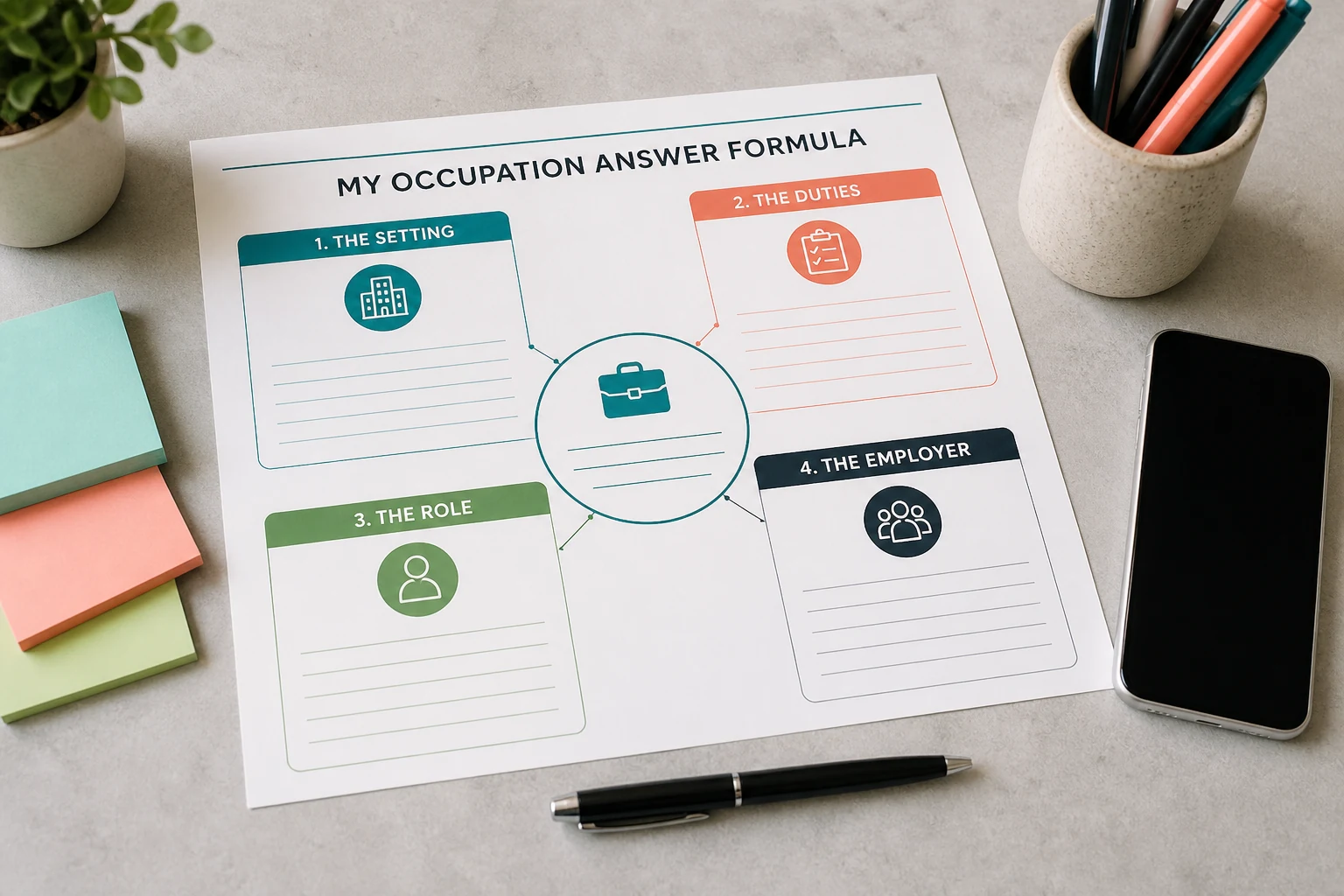
Use this quick formula:
- Name your main work setting.
- List your top three duties.
- Choose the broad role label that matches those duties.
- Use employer names only when the form asks where you work.
For example, if your setting is a warehouse and your top duties are scanning, packing, and moving orders, your occupation is probably "warehouse associate." If your setting is a restaurant and your top duties are greeting guests, taking orders, and bringing food, your occupation is probably "restaurant server." If your setting is school and your main responsibility is studying, your occupation is probably "student."
If two labels seem equally accurate, choose the one that would help a reader understand your skills fastest. "Customer service representative" may be more informative than "associate" if most of your day involves solving customer issues. "Inventory associate" may be better than "warehouse worker" if your role is mostly stock accuracy.
Use Your Occupation Answer as a Career Clarity Check
Once you know how to answer "what's my occupation?", pause for a second question: does this occupation match the kind of work you want more of? You do not need a perfect career plan to notice useful signals. Which duties feel satisfying? Which tasks drain you? Which skills would you like to use in a different setting?

If your current role is mostly physical and practical, you may want to explore hands-on career paths. If you enjoy serving, teaching, or supporting people, you may want to explore people-centered work. If you like structure, numbers, records, or repeatable systems, detail-oriented roles may be worth reviewing. RiasecTest.com frames this kind of reflection through Holland's RIASEC model, which groups career interests into Realistic, Investigative, Artistic, Social, Enterprising, and Conventional patterns.
You can use a Holland Code career exploration starting point to compare your interests with possible work environments. Keep the process low-pressure. Your occupation answer is not a final verdict on who you are. It is a practical label for today and a useful clue for what you may want to explore next.
FAQ
What is my occupation example?
An occupation example is a broad work label such as warehouse associate, retail sales associate, cashier, restaurant server, fast food worker, administrative assistant, student, caregiver, or retired person. The best example for you depends on your main duties and current situation.
What is your occupation mean?
"What is your occupation?" means "What kind of work do you do?" In most everyday settings, answer with your role or work category rather than your employer name. For example, say "retail cashier" instead of only naming the store.
What are 5 examples of occupations?
Five common examples are teacher, nurse, cashier, warehouse associate, and software developer. Other examples include restaurant server, office clerk, electrician, accountant, driver, and customer service representative.
What are the 8 occupations?
There is no single universal list of exactly 8 occupations. Different systems group work in different ways. In everyday use, you might see broad areas such as management, business, healthcare, education, construction, food service, sales, and office support.
Is occupation the same as job title?
Not exactly. A job title is the specific name of your position, often chosen by your employer. An occupation is the broader category of work. "Senior team member" might be a job title, while "retail sales associate" or "shift supervisor" is a clearer occupation.
What should I put if I work at Amazon, Walmart, or McDonald's?
Use the role that describes your duties. For Amazon, that might be warehouse associate, delivery driver, or customer service representative. For Walmart, it might be cashier, stocker, retail associate, or department supervisor. For McDonald's, it might be fast food crew member, cashier, cook, or shift manager.
What if I have more than one occupation?
Choose the occupation that best fits the purpose of the question. If a form asks for current main occupation, use the work you do most often or the work that provides your main income. If it allows details, you can write both, such as "student and part-time cashier."