What Are the Holland Codes: Guide to RIASEC Types
Choosing the right career path often feels like navigating without a map. You might wonder why some jobs drain your energy while others make you feel alive. The secret usually lies in "congruence"—how well your personality matches your work environment.
This is where the Holland Codes come in. Developed by psychologist Dr. John Holland, this theory offers a scientifically backed framework for job satisfaction. Before you decide to take the holland code test, it helps to understand the theory behind it. By identifying which of the six personality types you align with, you can narrow down career choices that truly fit who you are.
In this guide, you will learn exactly what the Holland Codes are, break down the six RIASEC types, and discover how your unique 3-letter combination can unlock your ideal career path.
The Theory Behind the Holland Occupational Themes
The Holland Codes, also known as the RIASEC model, are based on a simple yet powerful idea: people work best in environments that match their personalities.
Dr. John Holland developed this theory in the 1950s. He believed that most people can be categorized into one of six personality types. When you find a career that aligns with your dominant type, you are more likely to be successful, satisfied, and stable in your role.
The Core Philosophy: Matching Personality to Environment
The core philosophy is about "fit." If you are a social person who loves helping others, working in an isolated data lab might feel draining because the environment opposes your nature. Conversely, if you love structured tasks and clear rules, a chaotic artistic environment might cause unnecessary stress.
By understanding your Holland Occupational Themes, you stop guessing and start making evidence-based decisions about your future.
Understanding the Hexagon Model
You might see these codes arranged in a hexagon. This shape is not random. The Holland Hexagon shows the relationship between the types.
- Adjacent Types: Types next to each other (like Realistic and Investigative) share similar traits and often get along well.
- Opposite Types: Types across from each other (like Realistic and Social) tend to have different values and work styles.
Understanding this helps you see where your interests overlap and where they might conflict.
Breaking Down the 6 Holland Code Types
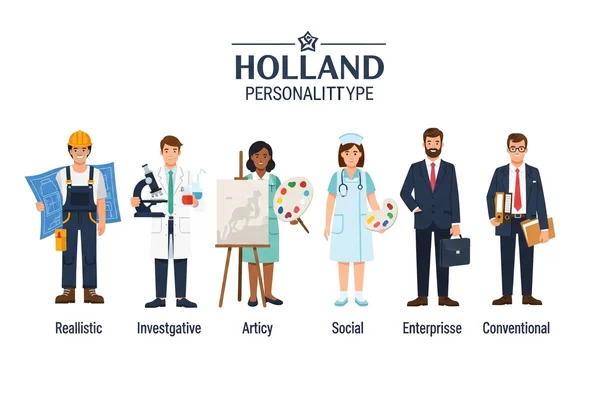
So, what are the holland codes exactly? The acronym RIASEC stands for the six personality types: Realistic, Investigative, Artistic, Social, Enterprising, and Conventional. Let’s break them down.
Realistic (The Doers): Practical & Physical
People with a Realistic code love to work with their hands, tools, plants, or animals. They are practical, grounded, and prefer tangible results over abstract theories. They typically avoid social activities like healing or informing others.
- Key Traits: Practical, mechanical, independent.
- Ideal Environment: Outdoors, engineering firms, construction sites.
Investigative (The Thinkers): Analytical & Curious
Investigative types are the problem solvers. They love to observe, learn, analyze, and solve complex problems. They value science and logic over persuasion. They prefer to work independently to understand the physical or cultural world.
- Key Traits: Analytical, intellectual, curious.
- Ideal Environment: Laboratories, universities, research centers.
Artistic (The Creators): Expressive & Original
Artistic individuals thrive on self-expression. They dislike rigid rules and prefer unstructured environments where they can use their imagination and creativity. They value aesthetics and emotional expression.
- Key Traits: Creative, intuitive, expressive.
- Ideal Environment: Theaters, design studios, museums, advertising agencies.
Social (The Helpers): Empathetic & Supportive
If you have a Social Holland Code, you likely enjoy working with people to enlighten, inform, help, train, or cure them. You are skilled with words and value relationships. You likely avoid using machines or tools to achieve a goal.
- Key Traits: Helpful, friendly, trustworthy.
- Ideal Environment: Schools, hospitals, counseling centers, non-profits.
Enterprising (The Persuaders): Ambitious & Energetic
Enterprising types like to work with people too, but for a different reason: to influence, persuade, or lead. They are goal-oriented and often enjoy business or politics. They value success, status, and leadership.
- Key Traits: Energetic, ambitious, sociable.
- Ideal Environment: Corporate offices, sales floors, courtrooms, real estate firms.
Conventional (The Organizers): Structured & Detail-Oriented
Conventional Holland Code types prefer working with data and numbers. They like structure, clear rules, and carrying out tasks in detail. They are the backbone of any organized system and often avoid unstructured or ambiguous activities.
- Key Traits: Efficient, careful, organized.
- Ideal Environment: Banks, accounting firms, administrative offices, quality control labs.
Quick Cheat Sheet: Which Keywords Describe You?
| Type | Keywords | "I Like To..." |
|---|---|---|
| Realistic | Practical, Physical | Build, repair, use tools |
| Investigative | Analytical, Logical | Solve, research, analyze |
| Artistic | Creative, Expressive | Create, design, write |
| Social | Helpful, Friendly | Teach, nurse, guide |
| Enterprising | Ambitious, Energetic | Lead, sell, manage |
| Conventional | Organized, Detail-oriented | Organize, file, calculate |
Beyond the Single Letter: Why Your "3-Letter Code" Matters
Most people do not fit perfectly into just one box. Human personality is complex. That is why professional assessments usually give you a 3-letter Holland Code (also called your RIASEC combination).
Why You Are More Than Just One Letter
Your 3-letter code represents your primary, secondary, and tertiary interests. For example, if your code is SEC (Social, Enterprising, Conventional), you are primarily a Helper, but you also have leadership skills and like organization.
This nuance is crucial. An "S" type might be a counselor. But an "SEC" type might be a school principal—someone who helps students (S) but also manages staff (E) and organizes school policies (C).
Does the Order Matter? Understanding Dominant vs. Secondary Traits
Yes, the order matters significantly. The first letter is your dominant trait and drives your core motivation. The second and third letters modify how that dominant trait is expressed.
- ARI (Artistic-Realistic-Investigative): An architect who designs creative (A) yet functional (R) buildings using engineering principles (I).
- AIR (Artistic-Investigative-Realistic): A scientific illustrator who uses art (A) to explain complex biology (I) with precision (R).
Understanding your full combination helps you find niche careers that use all your strengths, not just one.
Mapping Holland Codes to Real-World Careers
Once you know your code, you can start exploring specific job titles. Here are some common holland code careers list examples to get you started.
Common Careers for Each Type
- Realistic: Carpenter, Electrician, Pilot, Engineer. These roles reward hands-on skill and tangible output.
- Investigative: Biologist, Software Developer, Mathematician, Pharmacist. These roles reward deep thinking and complex problem solving.
- Artistic: Graphic Designer, Writer, Musician, Architect. These roles reward originality and non-conformity.
- Social: Teacher, Nurse, Social Worker, Counselor. These roles reward empathy and interpersonal communication.
- Enterprising: Sales Manager, Lawyer, Real Estate Agent, Entrepreneur. These roles reward leadership and goal attainment.
- Conventional: Accountant, Data Analyst, Librarian, Bank Teller. These roles reward accuracy and systematic organization.
Mismatch? What to Do When Your Job Doesn't Fit Your Code
If you discover your current job conflicts with your code (e.g., you are an Artistic type stuck in a Conventional data-entry role), you might feel burned out.
You don't always have to quit immediately. You can try "job crafting." Look for ways to bring your strengths into your current role. If you are Social but work in IT, volunteer to mentor new hires or lead team meetings. Small shifts can increase your satisfaction.
How to Find Your Accurate Holland Code

Reading the descriptions above probably gave you a hunch about your type. However, self-assessment can be tricky. We often bias our own view or confuse what we are good at with what we enjoy.
Why Guessing Your Code Can Be Misleading
It is easy to misjudge yourself. You might think you are "Enterprising" because you are ambitious, but a test might reveal you are actually "Investigative" because your ambition is driven by solving problems, not leading people.
Getting your exact 3-letter order wrong can lead you down the wrong career path. A standardized assessment cuts through the bias and gives you an objective starting point.
Start Your Journey with Riasectest.com
If you want to know for sure, taking a valid assessment is the best next step.
Our platform offers a user-friendly tool designed to help you explore these traits in depth. It isn't a medical diagnosis, but an educational resource to mirror your preferences back to you.
You can explore our interactive Holland Code assessment to uncover your specific 3-letter combination. Seeing your results can provide clarity and a vocabulary to describe what you need from your work life.
Your Personality is Your Career Compass
Understanding what are the holland codes is more than just learning six letters. It is about giving yourself permission to pursue work that feels natural to you.
Remember, your code is a compass, not a cage. It points you in the right direction but leaves you plenty of room to explore. Whether you are a student choosing a major or a professional looking for a change, aligning your career with your personality is the smartest move you can make.
Start exploring today. If you are ready for a comprehensive RIASEC evaluation, our tool is ready to help you find your way.
Frequently Asked Questions
What is the difference between Holland Codes and RIASEC?
There is no difference. They are two names for the same thing. "Holland Codes" refers to the theory created by Dr. John Holland, while "RIASEC" is the acronym for the six personality types he identified.
What is the difference between Realistic and Conventional types?
This is a common confusion. Realistic types like to work with things (tools, machines, plants) and often prefer being outdoors or using their hands. Conventional types like to work with data (numbers, files, records) and prefer structured office environments. Both are practical, but Realistic is "physical" while Conventional is "organizational."
Can my Holland Code change over time?
Your core personality traits are generally stable throughout adulthood. However, your secondary or tertiary letters might shift as you gain new life experiences or develop new skills. Your dominant type (the first letter) usually remains consistent.
Are Holland Codes scientifically valid?
Yes. The Holland Occupational Themes are one of the most widely researched and validated theories in vocational psychology. They are used by career counselors, universities, and the U.S. Department of Labor (O*NET) to classify jobs.
What if I feel like I fit into all categories?
It is rare to fit all six equally, but some people have "undifferentiated" profiles where their scores are very close. This usually means you are adaptable and can find satisfaction in many environments. Taking a scored assessment can help identify the slight preferences that still exist.