Skills vs Aptitudes with Examples and an Evidence Worksheet
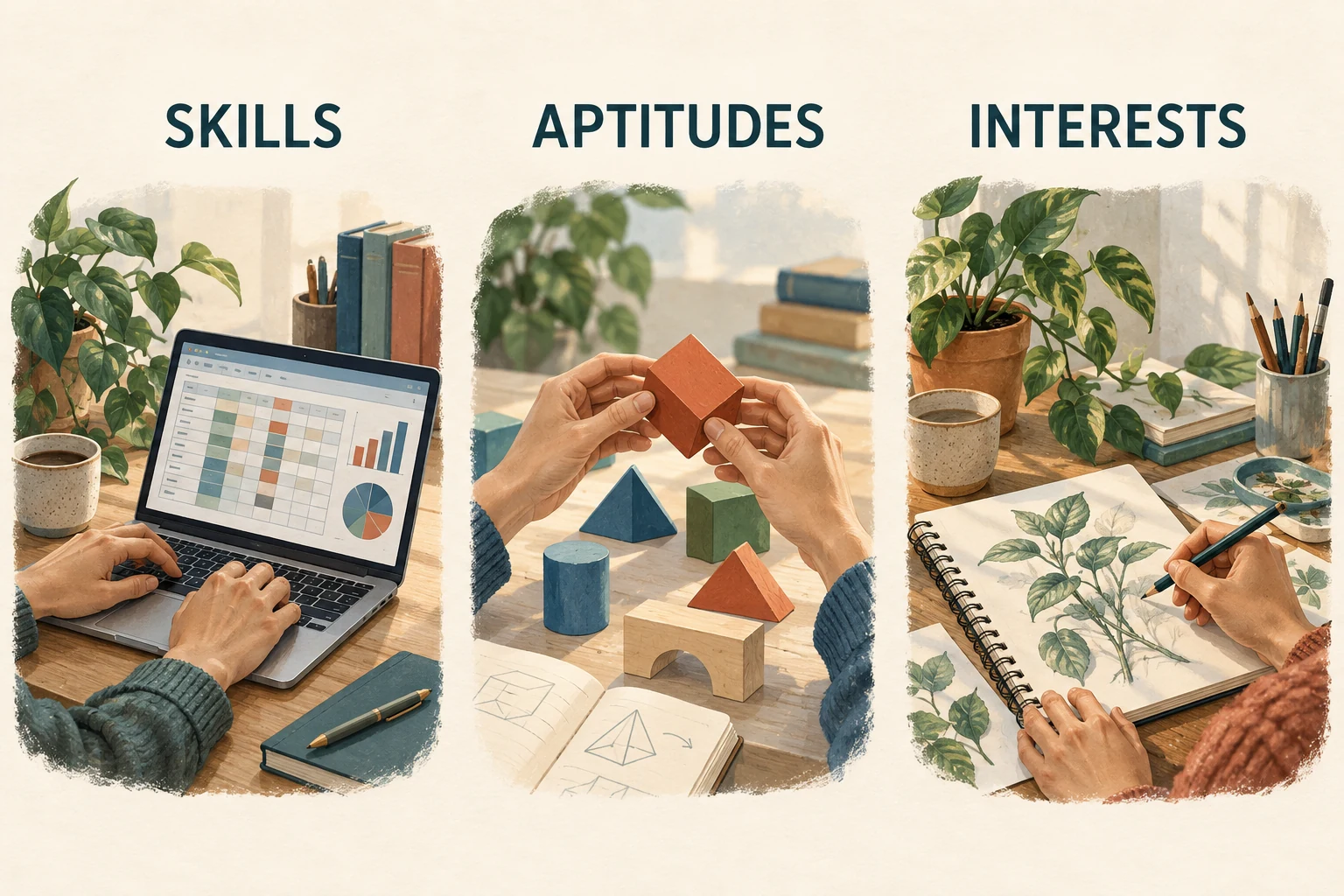
Skills are proficiencies developed through learning and practice; aptitudes are capacities relevant to learning or performing particular kinds of tasks. Editing a clear set of instructions is a skill. Understanding unfamiliar written arguments may provide a clue about verbal aptitude. Enjoying the editing process is an interest.
When you describe your strengths, these differences help you separate what you can already demonstrate from what you might develop. Use the examples and worksheet below to record skills and aptitudes without turning a single success, a test score, or a preference into a claim you cannot support.

What Is the Difference Between Skills and Aptitudes
The practical distinction is demonstrated proficiency versus capacities that may support learning and performance. They interact: an aptitude assessment can draw on learned knowledge, while a work sample can reveal both existing proficiency and how someone approaches a new problem.
| Concept | Main question | Example | Useful evidence |
|---|---|---|---|
| Skill | What can I perform competently now? | Creating a spreadsheet budget | A completed budget with checked calculations |
| Aptitude | What capacities may support learning or performance? | Reasoning about numerical relationships | Relevant assessments and patterns across learning experiences |
| Interest | What activities do I want to do? | Enjoying budget planning | Activities you choose and want to repeat |
Aptitude is sometimes described as natural talent, but that wording can hide the effects of education and experience. Finding a task easy does not establish that your advantage is inborn. Familiarity, instruction, language, and the conditions in which you work can all affect performance.
Skills include interpersonal actions as well as technical procedures. Giving useful feedback, summarizing a customer's request, and coordinating a schedule are learned skills. A broad description such as "good with people" needs a specific task before it becomes useful evidence.
Aptitude and Related Terms
Ability is a broader term that can refer to current performance or an underlying capacity. Aptitude usually emphasizes suitability or potential for a particular kind of task. Talent is an everyday description of a noticeable strength, rather than a consistently defined assessment category. Check how a test, school, or employer uses these words before comparing results.
Skills and Aptitudes Examples You Can Verify
Pair each possible capacity with a learned task and a way to check the result. The connections below are illustrative; they do not establish an aptitude profile or automatically match someone to a career.
| Possible aptitude | Related learned skill | Evidence of the skill |
|---|---|---|
| Verbal reasoning | Editing instructions for clarity | Another person completes the task using the revised instructions |
| Numerical reasoning | Building a spreadsheet budget | Formulas and totals agree with the source records |
| Spatial visualization | Producing a technical drawing | Dimensions and views accurately represent the object |
| Mechanical reasoning | Troubleshooting equipment | A fault is identified through an appropriate, systematic process |
| Finger dexterity | Sewing small stitches | A finished seam is precise and consistent |
Notice what the last column proves. A correct drawing supports a claim about drawing proficiency. It does not, by itself, measure spatial aptitude independently of training. If you want to describe learning potential, also record the starting point, instruction received, and progress across attempts.
A Student with a Possible Strength and Little Experience
Suppose a student readily understands how pieces fit together but has never used design software. "Proficient in CAD" would be an unsupported skill claim. "Interested in design and exploring spatial tasks" describes a starting point more accurately.
After completing a beginner tutorial, the student can keep a dimensioned drawing and feedback on its accuracy. That adds evidence of a developing skill. If similar learning patterns appear across several unfamiliar tasks, the student has more information to discuss with a teacher or adviser, while still distinguishing informal observations from assessment results.
An Experienced Worker with a Skill They Do Not Enjoy
A customer service worker may handle requests accurately after years of practice while finding the work draining. Their skill remains useful evidence. Their lack of interest is a separate observation, and neither establishes their aptitude for every job involving people.
The same distinction applies to hobbies. Enjoying music is an interest; playing an instrument competently is a skill. Learning unfamiliar rhythmic patterns readily may suggest a relevant learning strength, but one attempt is limited evidence.
Build Your Skills and Aptitudes Evidence Worksheet
Choose three specific tasks from school, work, volunteering, household responsibilities, or hobbies. For each task, complete both tables below. Copy the pair into a document or notebook and repeat it for your other tasks.
Record What You Can Demonstrate
| Task completed | Learned skill | Evidence you can check |
|---|---|---|
| What did you actually do? | What action can you now perform? | What sample, feedback, or outcome supports that claim? |
Keep the skill narrower than the activity. "Organized an event" might involve several skills: scheduling volunteers, comparing supplier costs, and writing attendee instructions. Choose one at a time so the evidence matches the claim.
Record Learning and Interest Separately
| Learning observation | Interest | Next check |
|---|---|---|
| What was unfamiliar, what help did you receive, and what changed with practice? | Which part did you enjoy or want to repeat? | What task or feedback would clarify a remaining question? |
Use observations rather than assigning yourself an aptitude score. "After a demonstration, I used a formula correctly in a second example" records a learning experience. "High numerical aptitude" claims more than that experience can establish.
For the next check, name a task and a success criterion. "Improve spreadsheets" is difficult to evaluate. "Build a new budget from a different set of receipts and check every total against the records" gives you something concrete to inspect.
Worked Example of a Completed Worksheet
These entries illustrate how a volunteer might record two tasks. They are examples, not assessment results.
| Task completed | Learned skill | Evidence you can check |
|---|---|---|
| Created an event budget | Entering expenses and checking spreadsheet totals | Spreadsheet reconciled with receipts and reviewed by the organizer |
| Prepared a volunteer schedule | Matching availability to required shifts | Rota showing coverage, with availability confirmed by volunteers |
| Task | Learning observation | Interest | Next check |
|---|---|---|---|
| Event budget | Learned a new formula after a demonstration; needed help choosing the correct cell range | Enjoyed checking totals more than entering receipts | Build a second budget and have someone check the formula ranges |
| Volunteer schedule | Learned the scheduling tool using its help guide; missed one availability change | Enjoyed coordinating people, but found repeated changes tiring | Revise a rota after changed availability and check for uncovered shifts |
The budget entry supports a current skill in recording and checking expenses. It also reveals a specific learning need: selecting formula ranges. It does not establish a numerical aptitude score. The schedule entry supports coordination experience while separating the enjoyable part from the tiring part.
Decide What Each Entry Supports
After filling in the worksheet, read each claim against its evidence:
- A demonstrated skill: you can point to an appropriate result and explain your contribution.
- A skill still developing: you completed part of the task, needed support, or found errors to address.
- A possible learning strength: you observed progress on unfamiliar tasks, with the prior experience and help recorded.
- An interest: you wanted to repeat an activity or preferred it to another part of the task.
An entry can support more than one observation. Keep each observation separate so you can update it when new evidence appears. If a result depended on a template or another person's help, include that context rather than treating it as independent proficiency.

Describe Skills and Learning on a Resume
A resume usually benefits from the task and evidence in your worksheet. Replace broad labels with an action you performed and a result you can honestly explain. Use the examples below only when they match your experience.
| Broad claim | More specific alternative |
|---|---|
| Excellent numerical aptitude | Maintained an event budget spreadsheet and checked expenses against receipts |
| Good with people | Gathered volunteers' availability and coordinated shift coverage |
| Fast learner | Learned the team's scheduling software during induction and used it to prepare weekly rotas |
| Strong verbal ability | Revised attendee instructions after feedback and checked that the steps were clear |
The revised wording shows relevant experience without presenting a self-impression as a verified aptitude result. If your experience was limited to a course or supervised project, say so. If an employer requests formal assessment results, provide them in the requested format rather than substituting an informal worksheet.
What Are the 9 Aptitudes in the GATB
There is no universal list of exactly nine aptitudes. The historical General Aptitude Test Battery (GATB) uses a nine-part framework. An official GATB report available from O*NET lists the categories and definitions on printed pages 2–3.
The descriptions here are brief paraphrases of that framework.
| GATB aptitude | Plain-language description |
|---|---|
| General learning ability | Understanding instructions and principles; reasoning |
| Verbal aptitude | Understanding and using words and written ideas |
| Numerical aptitude | Performing arithmetic accurately and quickly |
| Spatial aptitude | Visualizing shapes and objects in space |
| Form perception | Noticing small visual differences in shapes and details |
| Clerical perception | Checking details in words, numbers, and records |
| Motor coordination | Coordinating precise eye and hand movements |
| Finger dexterity | Manipulating small objects with the fingers |
| Manual dexterity | Moving the hands skillfully to place and turn objects |
Other assessments organize capacities differently. Mechanical reasoning, used in the earlier examples, is not a separate category in this nine-part list. The GATB categories also differ from the six RIASEC interest types: capacity and preference answer different questions.
Use this list to understand terminology, rather than to score your worksheet. An everyday task may involve several capacities and learned skills at once. Checking an event budget, for example, requires familiarity with the spreadsheet as well as attention to records and calculations.
When to Add an Assessment to Your Worksheet
Your worksheet records experience; it is not a standardized aptitude test. If you need information about learning potential, see the aptitude test guide. If you need to demonstrate readiness for a particular role, the job assessment guide explains skills tests and work samples.
For the interest column, a RIASEC career interest assessment can help you name preferences. It does not supply evidence for the skill column or establish an aptitude score. When you are ready to compare broader career options, use the career fit guide alongside your completed worksheet.
Choose your next step from a gap in the evidence: a skill to practice, a result to get reviewed, or a learning observation to investigate. Then add the new result to the same worksheet so your description of your strengths becomes more specific over time.
Frequently Asked Questions
What Are Some Skills and Aptitudes
Skills include writing reports, managing schedules, coding, and giving presentations. Aptitudes can include verbal reasoning, numerical reasoning, spatial visualization, and manual dexterity. A related aptitude may support learning, while proficiency in the task still requires relevant experience and practice.
Can You Have an Aptitude without the Related Skill
Yes. Someone may show a capacity relevant to spatial tasks before learning technical drawing. The distinction is between a capacity that may support learning and proficiency they can already demonstrate. Use a relevant assessment or repeated learning observations to investigate the former, and a work sample to check the latter.
What Should I Put in a Skills and Aptitudes List with No Work Experience
Start with school, household, hobby, or volunteer tasks. Name what you did, identify a skill, and record a sample or feedback. Keep possible learning strengths in a separate column. You do not need an employer to have useful evidence, but you do need context for each claim.
What Are Aptitude Skills
"Aptitude skills" is an informal phrase rather than a single standardized category. It may refer to reasoning abilities or tasks used in aptitude testing. Replace it with the specific capacity or learned skill you mean, such as numerical reasoning or checking spreadsheet formulas.
Can Aptitudes Improve through Learning
Practice can improve performance on related tasks. Whether that improvement transfers to a broader capacity depends on the task and assessment. In your worksheet, record what improved and under which conditions instead of treating a better result as proof of a general aptitude change.