Interest Inventory Definition, Types and How It Works
Choosing a career path often feels like standing at a massive intersection without a map. You might feel overwhelmed by the sheer number of options, uncertain about what you truly enjoy, or isolated thinking everyone else has it figured out. These feelings are valid and incredibly common, but you do not have to navigate them alone.

An interest inventory is a psychological assessment designed to help you cut through the noise. Unlike a test that you pass or fail, this tool acts as a mirror, reflecting your preferences back to you in a structured way. By comparing your likes and dislikes against proven data, a reliable career interest inventory helps you identify work environments where you are most likely to thrive. Whether you are a student choosing a major or an adult seeking a change, understanding this tool is the first step toward professional clarity.
What Is an Interest Inventory? (Definition vs. Aptitude)
At its core, an interest inventory is a self-assessment tool used in career counseling to measure your preference for a variety of activities, work environments, and subjects. It helps answer the fundamental question, "What do I like to do?" rather than "What am I good at?"
Many people feel confused because they conflate talent with enjoyment. Just because you are good at math doesn't mean you will be happy as an accountant. Recognizing this distinction can make you feel relieved—you are allowed to pursue what fulfills you, not just what you can tolerate. By focusing on the interest inventory definition, we see that it is about motivation, not just capability.
Defining the Tool: A Compass, Not a GPS
Think of an interest inventory as a compass. A GPS tells you exactly where to turn and when to arrive. A compass, however, points you toward a general direction—North, South, East, or West.
Similarly, these assessments won't hand you a single, magical job title that solves all your problems. Instead, they highlight a direction. They might suggest that you lean toward creative fields, analytical roles, or social services. This broad guidance helps you focus your exploration on areas where you are naturally motivated, saving you from wasting time on paths that don't fit your core personality.
Interests vs. Aptitude: The Key Difference
It is crucial to understand that an interest inventory is not an aptitude test. Understanding the difference prevents misalignment in your career planning.
- Aptitude Tests measure ability, skill, and potential to learn specific tasks (e.g., verbal reasoning, numerical ability).
- Interest Inventories measure preference, motivation, and enjoyment (e.g., helping people, working with machines).
You might have high aptitude for sales (you are persuasive) but low interest in it (you find it draining). A sustainable career decision lies at the intersection of what you can do and what you want to do.
The Science: What is "Person-Environment Fit"?
Most modern inventories are based on the theory of "Person-Environment Fit." This psychological concept suggests that people search for environments that will let them exercise their skills and abilities, express their attitudes and values, and take on agreeable problems and roles.
When your personality matches your work environment, you are more likely to be satisfied, persistent, and successful. This is why an interest inventory is so valuable—it scientifically matches your profile to compatible work settings.
3 Common Examples of Interest Inventories
There are several types of interest inventory assessments used by schools, career centers, and corporations. While they may use different names, most rely on similar psychological frameworks to help you understand your professional needs.
The Strong Interest Inventory (The Paid Standard)
The Strong Interest Inventory (SII) is one of the oldest and most well-known assessments in the world. It provides a detailed report comparing your interests to those of people happily employed in specific occupations.
- Pros: Highly detailed and backed by decades of research.
- Cons: It is typically not free. It usually requires administration by a certified counselor and can be expensive to access.
The RIASEC / Holland Code Model (Our Free Focus)
The RIASEC model, developed by psychologist John Holland, is the theoretical backbone for many assessments, including the Strong Interest Inventory. It categorizes interests into six types: Realistic, Investigative, Artistic, Social, Enterprising, and Conventional.
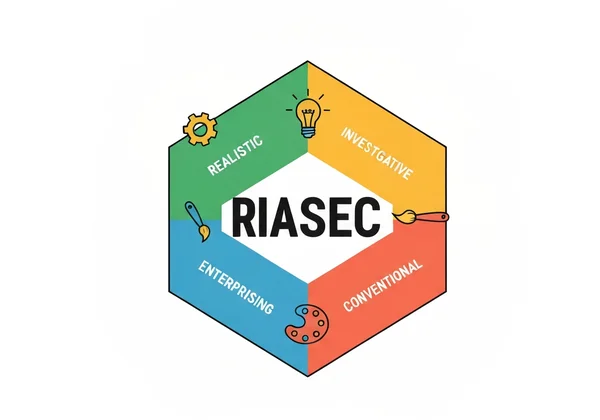
Because this model is widely scientifically accepted, you do not always need to pay for a "brand name" test to get the benefits. We provide a comprehensive, free RIASEC assessment that uses this exact scientific framework. It allows you to generate your profile instantly without the barriers of cost or appointment scheduling.
The O*NET Interest Profiler (Government Tool)
Sponsored by the U.S. Department of Labor, the ONET Interest Profiler is another common tool. It is linked directly to the massive ONET database of occupational information. It is excellent for users who want to connect their results strictly to U.S. labor market data, though the interface can sometimes feel less intuitive for casual users compared to modern alternatives.
How Does an Interest Inventory Work? (Process & Scoring)
If you have never taken one before, the idea of a "psychological test" might feel intimidating. You might worry about being judged or labeled. However, the process is actually quite simple and low-pressure.
Question Formats: Likes, Dislikes, and Indifference
An interest inventory assessment typically presents you with a series of statements describing various activities. These describe the nature of work rather than specific job titles. For example:
-
"Build kitchen cabinets."
-
"Write a script for a movie."
-
"Manage a department store."
-
"Teach adults to read."

For each statement, you simply indicate your level of preference. This usually ranges from "Strongly Dislike" to "Strongly Like." The goal is to capture your visceral reaction to the activity itself, regardless of whether you have the education or training to do it right now.
No "Right" or "Wrong" Answers: Understanding Validity
There are absolutely no right or wrong answers. You cannot "fail" an interest inventory.
- If you dislike everything related to science, that is not a failure; it is a data point.
- If you love art but hate business, that is a valuable insight.
The validity of the results depends entirely on your honesty. The system looks for patterns in your answers. If you consistently rate "helping" activities highly, the scoring algorithm identifies a "Social" preference. Trying to "game" the test to get a specific result only hurts your own self-discovery.
Scoring: How Your 3-Letter Code is Generated
After you complete the questions, the system tallies your responses across different categories. In the RIASEC system, for example, your top three highest-scoring areas become your "Holland Code" (e.g., "AES" for Artistic-Enterprising-Social). This code acts as a shorthand for your professional personality, unlocking a database of careers that align with that specific combination.
Who Should Take an Interest Inventory?
While anyone can benefit from self-knowledge, certain life stages make this tool particularly effective. You might feel stuck in a routine or frightened by an upcoming transition. In these moments, objective data can be a grounding force.
High School & College Students: Choosing a Major
For students, the pressure to "pick a path" can be paralyzing. Questions like “What if I choose the wrong major and waste four years?” are common. An interest inventory for students provides the vocabulary to explain their choices.
It validates why a student might feel drained in a biology lab but energized in a debate club. It helps narrow down thousands of college majors to a manageable list of "best fit" options, saving time and tuition money by preventing major-switching later in their academic career.
Adults: Navigating Career Changes and Burnout
For adults, the need for an inventory often stems from burnout or dissatisfaction. You might be competent at your job but feel empty at the end of the day. This often happens when there is a mismatch between your interests and your daily tasks. An interest inventory for adults helps identify "transferable interests."
- The Career Changer: If you are a teacher looking to leave the classroom, an inventory might show you enjoy the "content creation" (Artistic) side of teaching more than the "instruction" (Social) side, pointing toward a new career in instructional design or writing.
- The Burnout Check: Sometimes, simply seeing that your current job aligns with your lowest-interest category validates your feelings. It confirms that you aren't "lazy" or "ungrateful"—you are just in the wrong environment.
Note: While these tools help with career dissatisfaction, if you are experiencing severe anxiety or depression, please seek support from a mental health professional.
5 Steps to Using Your Results for Career Planning
Taking the interest inventory is just the first step. The real value comes from what you do with the results. Do not just look at your code, nod, and close the browser. Use this action plan to turn insight into reality.

1. Understand Your Code
Don't just memorize the letters (e.g., "I am an IRC"). Read the descriptions of your primary types deeply.
- What drives a "Realistic" person? (Usually hands-on, tangible results).
- What motivates an "Investigative" person? (Solving abstract problems).
- Does this resonate with how you see yourself?
2. Explore Matching Careers (Not Just Job Titles)
Look at the list of careers associated with your code.
- Don't panic if you see a job you don't like.
- Look for patterns. Are many of the jobs in healthcare? Are they mostly outdoors? Are they independent or collaborative?
- Focus on the nature of the work rather than the specific job title.
3. Identify Skill Gaps vs. Interests
You might have a high interest in "Computer Programming" (Investigative) but zero coding skills.
- The Gap: The distance between your interest and your current ability.
- The Action: This gap defines your next educational step. Do you need a bootcamp? A degree? Or just an online course?
4. Consult a Career Counselor or AI Guide
Bring your results to a mentor or career counselor. Instead of asking "What should I do?", you can ask: “I took an interest inventory and scored high in Artistic and Social. How can I apply this to the business world?” Modern platforms often provide AI-driven analysis to help interpret these nuances instantly.
5. Real-World Testing: Internships and Volunteering
Data is great, but experience is better. If your inventory points toward "Social" work:
- Volunteer at a shelter for a weekend.
- Shadow a social worker.
- See if the reality of the work matches the theory of your interest.
Start Your Journey of Self-Discovery
It is easy to feel skeptical about online tests. You might worry that a computer program can't possibly understand the complexity of who you are. And you are right—no tool can define you completely.
However, an interest inventory isn't meant to define you; it's meant to reveal you. It strips away the expectations of parents, the pressure of salary rankings, and the noise of social media, leaving you with a clear picture of what you genuinely enjoy.
Whatever your stage in life, clarity is the precursor to confidence. You don't have to map out your entire life today. You just need to know which direction to start walking. Take the first step and discover your Holland Code today.
Frequently Asked Questions
Are there free interest inventories available online?
Yes. While some clinical assessments like the Strong Interest Inventory are paid, high-quality free alternatives exist. We offer a free, scientific assessment based on the RIASEC model that provides instant results and detailed career reporting.
Is an interest inventory the same as a personality test?
Not exactly. A personality test (like Myers-Briggs or Big Five) measures how you interact with the world (e.g., introversion vs. extroversion). An interest inventory measures what you like to do (e.g., working with data vs. working with people). Both are useful, but they measure different things.
Can my interest inventory results change over time?
Yes, but they tend to stabilize in adulthood. Your interests may fluctuate wildly in your teens, but by your mid-20s, your core preferences (like enjoying creative work vs. analytical work) often remain relatively consistent, even if the specific job titles you pursue change.
What if my results don't match my current job?
This is very common and often explains feelings of burnout or boredom. It doesn't necessarily mean you must quit tomorrow. It might mean you need to "job craft"—adjusting your current role to include more tasks that align with your high-interest areas—or start planning a long-term transition.
How long does it typically take to complete an assessment?
Most modern online inventories are designed to be efficient. Our assessment typically takes about 5 to 10 minutes to complete, making it a quick but powerful way to start your career planning journey.