Identifying What My Interests Are: How to Map Core Passions
Waking up every day to a routine that feels empty can leave you asking a fundamental question: what are my interests? When you are stuck in professional burnout or transitional choice paralysis, your true passions often become completely obscured. You are not alone in this fog; thousands of students and career changers look at blank self-assessment pages daily, unsure of what genuinely sparks their internal drive. This educational guide provides a structured, scientific path to clear that confusion. By learning to distinguish temporary hobbies from core vocational traits and utilizing proven psychological frameworks, you will discover exactly how to uncover and map your authentic life interests.

What Does Personal Interest Mean? Unpacking the Essence of Human Passions
To understand your true path, you must first clarify what a personal interest actually means within the field of vocational psychology. Many people confuse situational excitement with long-term engagement. When you understand your core patterns, navigating major life choices becomes much simpler and more predictable.
The Psychology Behind Core Personal Interests
A core interest is not just a random activity that catches your attention for an afternoon. Psychologists define a vocational interest as a stable, internal preference for certain types of environments, tasks, and problems. These preferences develop early in life through a combination of genetic traits, early childhood experiences, and social interactions. They remain remarkably consistent throughout adulthood. When you find an environment that matches your deep interests, your brain experiences higher engagement. This alignment triggers organic focus, natural curiosity, and sustained energy. Therefore, identifying these patterns helps you predict where you will naturally thrive over the long term.
Fleeting Hobbies vs. Sustainable Professional Identity
It is vital to separate a fleeting hobby from a sustainable career interest. Hobbies often serve as temporary escapes from stress, providing quick relaxation without requiring deep professional commitment. For example, you might enjoy baking bread on weekends to unwind, but you may dislike managing a commercial kitchen inventory. In contrast, a career interest involves a deeper desire to master a specific domain or solve a particular class of problems. If you want to know what are my interests in life, you must look past the superficial activity. Instead, focus on the underlying functional task. Do you love the artistic design of the pastry, or do you love organizing the recipe data? True career clarity emerges when you identify these sustainable themes.
How Do I Find Out What My Interests Are When I Feel Stuck?
When choice paralysis or workplace stress numbs your motivation, finding your baseline can feel nearly impossible. However, you can reclaim your direction by using structured self-reflection tools.
Three Critical Self-Reflection Questions to Ask Tonight
To kickstart your exploration, clear away distractions and answer these three objective questions honestly. Writing down your answers will reveal immediate clues about your intrinsic motivation.
- The Resource-Independent Question: If all career paths paid the exact same salary and held identical social status, what specific tasks would you volunteer to perform tomorrow morning?
- The Frustration-Tolerance Question: What complex problems or messy tasks do you actually enjoy troubleshooting, even when the process becomes repetitive, tedious, or tiring?
- The Consumption Audit Question: When you browse articles, books, podcasts, or videos purely for entertainment, what specific topics do you return to automatically?
Why Career Burnout Obscures Your Natural Professional Passions
If you are currently asking why do I feel like I don't have any core interests or hobbies, the culprit is frequently career burnout. Chronic workplace stress alters your brain chemistry, pushing you into a state of emotional exhaustion and detachment. When your mind focuses entirely on basic survival and energy conservation, your capacity for natural curiosity drops significantly. This emotional numbness does not mean your passions have vanished permanently. Rather, your internal interests are simply dormant under a heavy layer of exhaustion. Recognizing this state prevents you from forcing premature career decisions while your energy reserves are empty. Give yourself space to rest before attempting deep professional repositioning.
Interests vs. Skills: Why Competence Does Not Equal Passion
A dangerous trap in career planning is building a life strategy solely around your current skills. Being highly proficient at a task does not mean that task satisfies your internal needs.
Many professionals find themselves trapped in golden cages because they confuse what they can do with what they love to do. For instance, you might possess excellent data entry skills because of your previous employment history. However, if looking at spreadsheets drains your vital energy, that skill represents a learned competence rather than an authentic vocational interest. To understand your profile clearly, review the structural differences outlined in the framework below:
| Dimension | Skills & Competences | Authentic Career Interests |
|---|---|---|
| Origin | Acquired through repetition, formal training, and external necessity. | Developed from internal curiosity and natural behavioral leanings. |
| Energy Impact | Often drains energy if executed without personal alignment. | Recharges energy, creating psychological flow and sustained focus. |
| Primary Focus | How effectively you perform a specific task right now. | Why you want to engage with a specific problem over the long term. |
| Adaptability | Can become obsolete due to automation or industry shifts. | Remains stable, shifting naturally to new, related job titles. |
To avoid long-term dissatisfaction, your career strategy should prioritize interests first, then use your skills to support those interests. If you need a reliable method to sort through these elements systematically, establishing a clear baseline of your unique interests can clarify your trajectory.
The Science of Interest Mapping: Introducing the Six RIASEC Archetypes
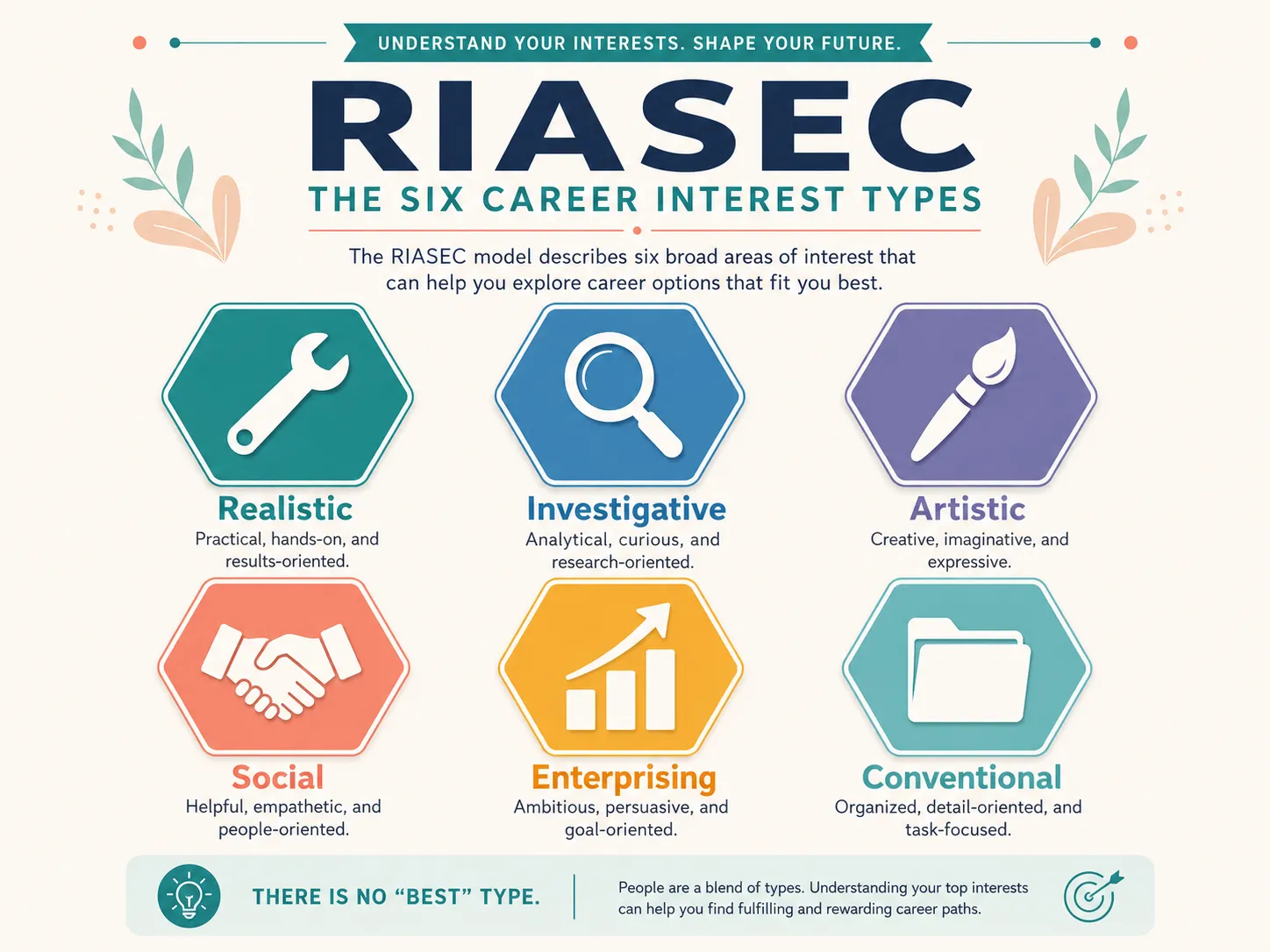
Instead of relying on guesswork, you can use established vocational science to organize your personal observations. Dr. John Holland developed a widely validated model that categorizes human interests into six structural archetypes, known collectively as the six riasec frameworks.
The Realistic Type: Hands-On and Technical Problem-Solving
People with realistic interests prefer working with tangible objects, tools, machines, plants, or animals. They value concrete results, outdoor environments, and practical solutions. If you enjoy engineering, building, or repairing physical systems, your profile likely contains a strong realistic component.
The Investigative Type: Analytical Research, Science, and Data
Investigative individuals gravitate toward observation, learning, and theoretical evaluation. They love exploring complex questions, analyzing data patterns, and solving scientific mysteries. If you automatically ask how does this system function when facing a problem, you align with this type.
The Artistic Type: Unstructured Creative Expression and Design
Artistic profiles look for open, fluid environments where they can express their individuality, ideas, and emotions. They dislike rigid rules, repetitive routines, and strict conformity. This area includes graphic design, creative writing, musical composition, and innovative culinary arts.
The Social Type: Human Connection, Teaching, and Service
The social archetype values helping, teaching, advising, and healing other human beings. These individuals thrive in cooperative team settings and excel at communication. They naturally focus on elevating the well-being of others rather than working with cold machinery or abstract data.
The Enterprising Type: Strategic Leadership, Business, and Persuasion
Enterprising personalities love leading projects, persuading clients, managing businesses, and taking calculated financial risks. They are highly motivated by organizational goals, public influence, and commercial growth. They enjoy sales, politics, executive management, and entrepreneurship.
The Conventional Type: Structural Accuracy, Data, and Organization
Conventional types find satisfaction in order, accuracy, systematic tracking, and structured data environments. They excel at managing logistics, financial records, mathematical data, and quality control systems. They value predictability, clear corporate procedures, and detail-oriented precision.
Embracing Self-Discovery: Why a Standardized Screening Scale Is Your Practical Next Step
Once you understand the six RIASEC dimensions, you can transform your unorganized thoughts into an actionable roadmap. This structural shift moves you away from generic confusion and guides you toward deliberate action.
Turning Chaos into Clarity: How Frameworks Map a Messy List of Hobbies
When you look at a chaotic list of personal hobbies, making a logical career decision seems impossible. You might see disconnected entries like fixing old furniture, reading detective novels, and volunteering. However, applying a vocational framework reveals the underlying patterns. Fixing furniture highlights a Realistic preference for hands-on tasks. Reading mystery novels points to an Investigative love for analytical puzzles. Volunteering reveals a Social drive to help people. By grouping your casual habits into these scientific buckets, you change a messy list of activities into a strategic profile.
Finding Your Baseline with an Educational Self-Reflection Tool
To map these traits accurately, you do not need an expensive or high-pressure process. Instead, you can gather immediate, reliable data through an educational checklist. Our platform provides a simple, structured method to help you sort your daily preferences into a personalized profile. By using this tool as an objective baseline, you can clarify your primary categories without making stressful, binding commitments. To see how your unique preferences align with real-world settings, completing an online riasec test online can serve as an empowering starting point for your ongoing self-reflection.

Navigating Your Next Steps with Clarity
As you continue your journey of self-exploration, remember that identifying your interest profile is an evolving process rather than a single, fixed event. Your primary vocational tendencies will remain stable, but the specific ways you apply them will adapt as you gain life experience. Also, keep in mind that online tracking assets are designed for educational guidance and personal reflection. They serve as an excellent starting point, but they do not represent a permanent or restrictive judgment on your future options.
If you are facing severe choice paralysis, significant workplace distress, or major professional transitions, you should treat your self-reflection patterns as a helpful baseline for further discussion with a qualified career advisor. Use these insights to start meaningful conversations, explore new possibilities, and step forward with confidence.
Frequently Asked Questions
What are some examples of personal interests for students?
Student interests usually mirror early vocational archetypes across academic and extracurricular settings. For instance, a student who loves technical lab experiments shows strong Investigative traits. Meanwhile, building yearbook designs highlights Artistic interests, whereas organizing study groups or volunteering as a peer tutor reflects Social preferences.
What are your top 3 interests or hobbies?
To find your top three elements, analyze where you spend your free time and mental energy. Review your web history or library lists to see what topics you explore automatically. Finally, group these actions into functional themes like hands-on tasks, analytical puzzles, or team logistics.
Can a person's core interests completely change as they enter adulthood?
While primary interest foundations remain stable throughout adulthood, the specific ways you express them adapt over time. For example, an Artistic individual might switch from painting canvas to designing corporate user interfaces. This adjustment reflects a natural market adaptation rather than a sudden shift in traits.
How can I discuss my self-reflection patterns with a qualified career advisor?
The most effective way to talk with a professional advisor is to bring organized notes from your self-assessments. Show them your top RIASEC themes or your specific core reflection responses. This balanced framework gives your consultant a structured baseline for providing personalized advice.