How to Find Out What Job Is Right for You
Figuring out how to find out what job is right for you can feel like trying to solve a puzzle without all the pieces. Maybe you're a student choosing a direction, or a professional wondering if something better is out there. Either way, the uncertainty is real — and completely normal. The good news is that career clarity isn't about a single flash of insight. It's a process you can follow, step by step. In this guide, you'll learn how to assess your interests and strengths, use career exploration tools like a RIASEC career interest test, avoid common decision-making traps, and build a practical plan for moving forward.

Why Finding the Right Job Starts with Self-Assessment
Before you start browsing job listings or asking friends for advice, there's a more important first step. You need to look inward. Understanding your own interests, skills, and values is the foundation of every good career decision.
Without self-assessment, you're essentially guessing. With it, you have a framework that helps you filter out noise and focus on what genuinely fits.
What Interests, Skills, and Values Reveal About Your Ideal Job
Your career interests point to the type of work that naturally energizes you. Think about the activities that hold your attention without effort — the subjects you'd explore even if nobody asked you to.
Your skills tell a different story. They reveal what you're already good at, whether through training, practice, or natural talent. When your skills overlap with your interests, that's where career satisfaction tends to live.
Then there are your values. These are the non-negotiables — the things that make work feel meaningful. Some common work values include:
- Autonomy — wanting control over how you work
- Helping others — finding meaning in service-oriented roles
- Stability — needing predictable income and structure
- Creativity — thriving when you can experiment and innovate
- Growth — wanting regular opportunities to learn and advance
When you match all three — interests, skills, and values — you're much closer to finding the right fit.
How to Tell the Difference Between a Hobby and a Career Interest
Not every passion makes a great career. A hobby is something you enjoy in your free time, often because there's no pressure attached. A career interest, on the other hand, is something you'd be willing to invest in, develop, and commit to — even when it gets hard.
Ask yourself these questions to test the difference:
- Would I still enjoy this if I had to do it on a deadline?
- Am I interested in the daily work, not just the highlights?
- Do I want to keep growing in this area, or is it purely recreational?
If the answers lean toward commitment and growth, that's likely a genuine career interest.
How Your Personality Affects Which Job Fits You Best
Your personality shapes how you work, what drains you, and where you thrive. Ignoring it when choosing a career is like buying shoes without checking the size — it might work for a while, but eventually the discomfort catches up.
Key Personality Traits That Influence Career Satisfaction
Several personality dimensions matter when it comes to career fit:
- Social orientation — Do you prefer working closely with people, or independently?
- Risk tolerance — Are you drawn to predictable environments, or do you enjoy uncertainty?
- Detail focus — Do you prefer structured, precise tasks or big-picture thinking?
- Energy source — Do you recharge through social interaction or solitude?
These traits don't limit your options. However, they can help you identify roles where you'll naturally perform well and feel more satisfied over time.
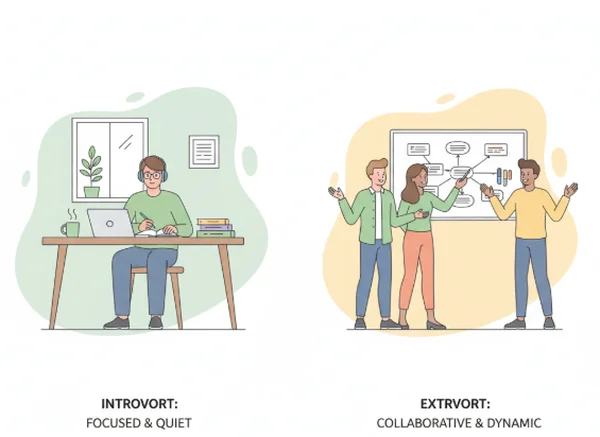
How Introverts and Extroverts Thrive in Different Work Settings
Introverts often do their best work in focused, low-stimulation environments. They tend to prefer roles that involve deep thinking, writing, research, or one-on-one interaction.
Extroverts, on the other hand, typically gain energy from collaboration, networking, and group settings. Sales, public relations, event management, and teaching are common fits.
Most people fall somewhere in the middle. The key is recognizing your tendencies so you can evaluate job environments more honestly.
How Career Interest Tests Can Help You Explore Options
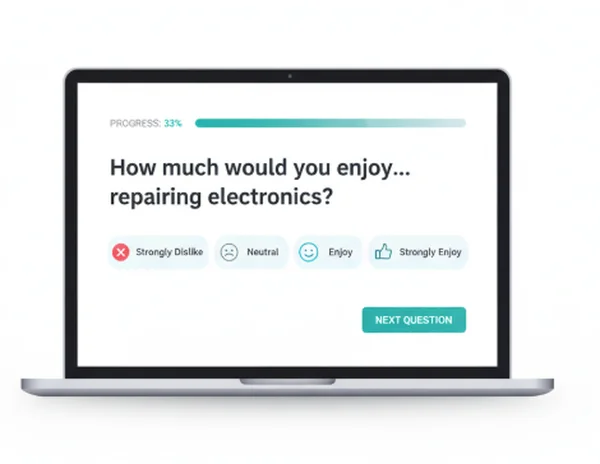
If self-reflection feels too abstract, a structured career interest test can bring clarity. These tools ask targeted questions about your preferences and map them to career categories — giving you a concrete starting point rather than a vague feeling.
What Is the RIASEC Model and How Does It Work?
The RIASEC model, developed by psychologist John Holland, categorizes career interests into six types:
- Realistic — hands-on, practical work (mechanics, engineering, agriculture)
- Investigative — analytical, research-based work (science, medicine, data analysis)
- Artistic — creative, expressive work (design, writing, performing arts)
- Social — helping and teaching others (counseling, healthcare, education)
- Enterprising — leading, persuading, managing (business, law, sales)
- Conventional — organized, detail-oriented work (accounting, administration, logistics)
After completing a RIASEC-based assessment, you receive a three-letter Holland Code — such as SAI or REC — that represents your top interest areas. This code helps you identify career directions that align with how you naturally think and work.
Curious about what your Holland Code might reveal? You can explore the RIASEC career interest test to organize your thinking and discover which career areas match your interests.
This assessment is designed for self-reflection and exploration — it is not a diagnostic tool and does not replace professional career counseling.
What Career Interest Test Results Can (and Can't) Tell You
Career assessments are useful, but they have clear limits. Here's what to keep in mind:
What they can do:
- Highlight interest patterns you may not have noticed
- Suggest career categories worth exploring
- Give you a vocabulary for describing your work preferences
What they can't do:
- Guarantee you'll love a specific job
- Replace deeper research and real-world experience
- Account for job market conditions or personal circumstances
Treat your results as a starting point for exploration, not a final answer.
What to Do After You Get Your Results
Once you have your results, the next step isn't to immediately apply for jobs. Instead, use them to guide focused research:
- Look up careers associated with your top interest areas
- Read about what people in those roles actually do day-to-day
- Identify 2–3 directions that feel worth exploring further
- Talk to someone who works in those fields
This process turns abstract results into real possibilities.
Practical Steps to Explore and Research Career Paths
Self-assessment and tests give you a starting direction. But nothing replaces hands-on exploration. Here are concrete steps you can take.
Use Informational Interviews to Get Insider Perspectives
An informational interview is a short, casual conversation with someone who works in a field you're curious about. You're not asking for a job — you're asking for insight.
Some useful questions to ask:
- What does a typical day look like in your role?
- What surprised you most about working in this field?
- What skills are most important for someone starting out?
- Is there anything you wish you'd known before entering this career?
Even one or two conversations can dramatically shift your perspective.
Try Job Shadowing, Volunteering, or Short Projects
Reading about a career and experiencing it are very different things. Whenever possible, try to get a firsthand look:
- Job shadowing lets you observe someone at work for a day or two
- Volunteering exposes you to a field while building skills and connections
- Freelance or short projects test whether you enjoy the actual work, not just the idea of it
These low-commitment experiments help you filter options before making a bigger decision.
Research Career Data and Growth Trends Online
Passion matters, but so does practicality. Before committing to a direction, research the basics:
- Average salary range for roles you're considering
- Job growth projections for the next 5–10 years
- Required education, certifications, or training
- Geographic demand (remote-friendly vs. location-specific)
Databases like O*NET OnLine and government labor statistics can provide this information for free.
Common Mistakes People Make When Choosing a Career
Knowing what to do matters. But knowing what to avoid can save you years of frustration.
Choosing Based on Salary Alone
A high salary is appealing, but if the daily work drains you, the paycheck won't compensate. Research consistently shows that career satisfaction depends more on interest alignment, autonomy, and a sense of purpose than on income alone.
This doesn't mean you should ignore money. It means salary should be one factor — not the only factor.
Waiting for the "Perfect" Career to Appear
Some people delay career decisions because they're waiting for a moment of absolute certainty. That moment rarely comes. Career exploration is more like a series of informed experiments than a single revelation.
The better approach: make the best decision you can with the information you have now, and stay open to adjusting as you learn more.
Ignoring Your Values and Work Environment Needs
You might love marketing as a concept. But if you value independence and end up in a highly bureaucratic corporate environment, you'll likely feel miserable — no matter how interesting the work is.
Always consider the environment, not just the role. Think about team dynamics, management style, flexibility, and company culture before committing.
What to Do When You Have No Idea What Career to Choose
If you've read this far and still feel stuck, that's okay. Many people feel completely lost when it comes to career direction — and there's a way forward even when nothing feels clear.
Why Feeling Lost About Your Career Is More Common Than You Think
Career uncertainty isn't a sign of failure. It's often a sign that you're taking the decision seriously. Most people don't have their career figured out by 20, 25, or even 35. Life circumstances, new interests, and evolving priorities change the picture constantly.
If you feel like everyone else has it figured out, remember: most of them are just as uncertain. They've simply taken a step forward and started learning from the experience.
A Simple 3-Step Framework for Getting Unstuck
When you're overwhelmed by options (or the lack of them), try this simple framework:
- Eliminate first, don't choose. Instead of finding "the answer," rule out categories you know don't fit. This narrows the field without the pressure of committing.
- Run small experiments. Take a free online course, attend an industry event, or shadow someone for a day. You're not deciding your future — you're gathering data.
- Set a 90-day focus. Pick one direction that seems worth exploring and commit to learning about it for 90 days. If it doesn't click, pivot to the next option.
This approach removes the paralysis of "choosing forever" and replaces it with "choosing for now."
Your Career Exploration Action Plan — What to Do Next
Finding the right job isn't about discovering one magic answer. It's about building self-awareness, exploring options, and taking informed action. Here's a quick checklist to get started:
- Reflect on your core interests, skills, and values
- Identify your personality-career tendencies
- Take a career interest assessment to organize your thinking
- Research 2–3 career directions that align with your profile
- Have at least one informational interview
- Set a 90-day exploration commitment
You don't need to have everything figured out today. What you need is a first step. If you're looking for a structured starting point, try the RIASEC career interest test to see which career directions connect with who you are.
Remember: career exploration is an ongoing process, not a one-time event. If you're feeling uncertain, consider speaking with a career counselor or mentor who can help you navigate your specific situation.
Frequently Asked Questions
How do I figure out what job is right for me?
Start by assessing your interests, skills, and values. Then use career tools like the RIASEC interest profiler to identify patterns, research matching career paths, and explore options through informational interviews or short-term experiences.
Is there a test to see what job I should have?
Yes — career interest tests like the RIASEC assessment measure your preferences across six vocational categories and suggest career directions that match. They're a helpful starting point for self-reflection, though results work best when combined with further research.
How do I choose a career when I have no idea what I want?
Begin by eliminating what you know doesn't fit. Then run small experiments — take courses, volunteer, or shadow professionals. Focus on gathering information rather than making a permanent decision.
What job am I best suited for based on my personality?
Your personality traits — such as social orientation, risk tolerance, and work style — influence which roles feel natural. Career interest assessments can map these traits to compatible career areas and help you explore options that align with who you are.
How do I know if I'm in the wrong career?
Common signs include persistent disengagement, dreading work regularly, feeling misaligned with your values, and a lack of growth or challenge. If these feelings persist, it may be worth reassessing your interests and exploring new directions.
Can a career interest test guarantee the right career choice?
No test can guarantee a perfect career match. Career assessments highlight patterns in your interests and suggest possible directions — but the final decision depends on deeper research, real-world experience, and personal reflection.