Career Quiz Personality Test: How to Choose and Use One
A career quiz personality test can be a useful first step when you are trying to connect who you are with what kind of work may fit you. Students may use one before choosing a major, adults may use one during a career reset, and job seekers may use one to explain their strengths with more confidence. The best results come when you treat the quiz as a structured reflection tool, not as a final verdict. If you want a Holland Code based starting point, a RIASEC career interest assessment can help you compare your interests with broad work environments and career themes.

What a Career Quiz Personality Test Actually Measures
Most career personality tools look for patterns in three areas: interests, work preferences, and self-described traits. Interests show what kinds of activities you tend to enjoy. Work preferences describe environments where you may feel more focused, such as hands-on settings, research spaces, creative studios, service roles, leadership contexts, or organized administrative systems. Personality signals add context about how you approach people, structure, uncertainty, and decisions.
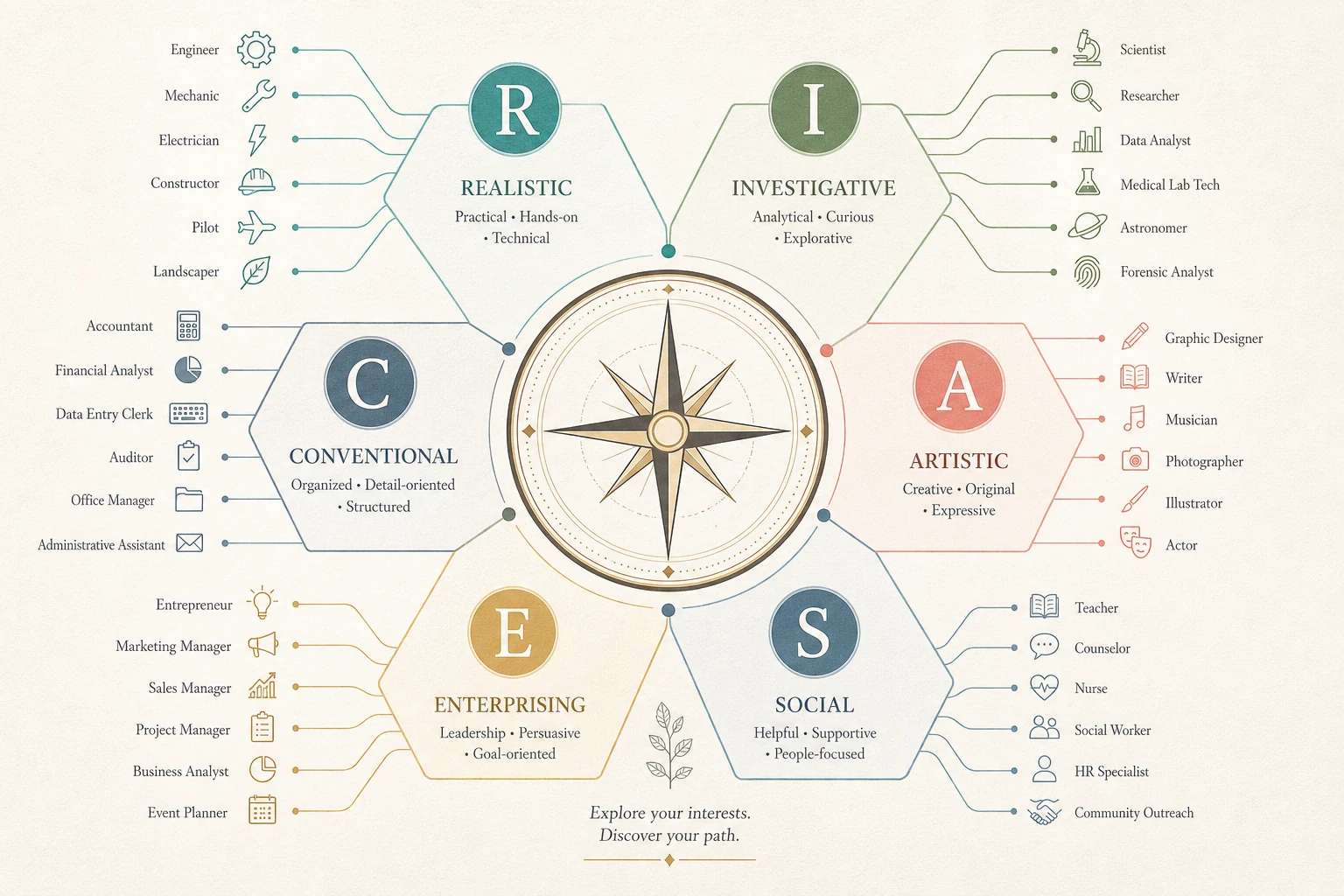
RIASEC, also called the Holland Code model, is especially common in career guidance because it links interests to six work themes: Realistic, Investigative, Artistic, Social, Enterprising, and Conventional. A result might show your top three themes, such as Social, Artistic, and Investigative. That does not mean you belong in only one job family. It means your answers point toward work activities worth exploring first.
This is where a career quiz differs from a simple job list. A job list tells you what exists. A quiz helps you ask why certain roles feel more natural than others. The strongest use is not "tell me the one right career." It is "show me a clearer set of options so I can research, compare, and test them in the real world."
Personality Tests vs Aptitude Tests vs Career Interest Inventories
Search results often mix these terms together, but they are not identical. Understanding the difference helps you choose the right tool.
A personality test describes tendencies in behavior and preference. It may explore how you make decisions, communicate, plan, adapt, or respond to structure. Personality can influence career satisfaction, but personality alone rarely explains the whole picture.
A career aptitude quiz focuses more on skills, abilities, and potential performance. It may ask about problem solving, numerical reasoning, spatial thinking, communication, or technical comfort. This can be useful, but aptitude should be paired with interest. Being capable of something does not always mean you want to do it every day.
A career interest inventory focuses on activities you like or dislike. RIASEC belongs here. It is often practical for students and adults because it starts with motivation and work themes instead of assuming you already know your dream role.
The best free career test for many people is not the longest one or the most dramatic one. It is the one that explains its framework, gives results you can understand, avoids absolute claims, and helps you plan a next step.

How to Choose the Best Free Career Test
Before you answer questions, look at how the test presents itself. A helpful career quiz personality test should make its method easy to understand. If it uses Holland Code, Big Five, work values, or another framework, it should explain what those categories mean in ordinary language.
Second, check whether the tool separates exploration from certainty. Strong tools use phrases like "may fit," "worth exploring," and "possible paths." Be careful with any quiz that promises one perfect job or claims it can decide your future without context.
Third, consider your life stage. A free career personality test for students should connect interests with majors, learning environments, and early exploration. A free career test for adults should leave room for existing skills, work history, constraints, and career change questions. A student PDF can be useful in a classroom, but an interactive online result may be easier to update and revisit.
Fourth, choose a test that gives you enough detail to act. A result that only says "creative" or "analytical" may feel nice for a minute, but it does not help much. Look for descriptions of work activities, environments, related fields, and reflection questions.
Finally, respect your own reaction. If a result surprises you, do not reject it too quickly. Ask whether it reveals an interest you have not named yet. If a result feels wrong, check whether you answered based on what sounds impressive rather than what you genuinely prefer.
What the Six RIASEC Career Personality Types Mean
The six RIASEC types are not labels. They are lenses for noticing the work activities that tend to hold your attention.
Realistic interests point toward practical, hands-on, mechanical, technical, outdoor, or tool-based work. People with strong Realistic themes may enjoy building, repairing, operating, testing, or working with physical systems.
Investigative interests point toward analysis, research, science, data, medicine, technology, or complex problem solving. These users often enjoy asking why something works and using evidence to reach a conclusion.
Artistic interests point toward creative expression, design, writing, performance, visual communication, or original problem solving. Artistic does not only mean fine art. It can also appear in product design, content strategy, architecture, media, and brand work.
Social interests point toward helping, teaching, coaching, counseling, training, health support, or community-facing roles. These users often feel energized by growth in other people.
Enterprising interests point toward persuasion, leadership, business, entrepreneurship, sales, management, advocacy, or influence. Enterprising users may enjoy setting goals, moving people toward action, and shaping outcomes.
Conventional interests point toward organization, data management, systems, procedures, finance, administration, compliance, or structured operations. These users often appreciate accuracy, order, and clear processes.
Many people are blends. Your top three themes matter more than a single highest score. For example, an Artistic-Social-Investigative pattern may point toward counseling communication, education design, UX research, or health communication. A Realistic-Investigative-Conventional pattern may point toward engineering technology, lab operations, data quality, or technical inspection.
How to Read Your Results Without Overreacting
Once you have a result, slow down. A career quiz personality test works best when you translate it into questions, not instant decisions.
Start by writing down your top themes and the phrases that felt accurate. Then mark anything that felt off. A mismatch can be useful because it shows where the quiz may not know your context. Maybe you like Artistic tasks but need income stability. Maybe you score high Social but feel drained by constant public interaction. Maybe you enjoy Investigative work but do not want a long graduate degree.
Next, separate career fields from daily tasks. "Healthcare" can include patient care, lab analysis, operations, education, technology, administration, and communications. "Tech" can include coding, product design, support, cybersecurity, data, sales, training, and project management. Your result should help you compare the task level of work, not just the industry label.
Then make a short experiment list. Choose three possible paths and research the daily work, required training, entry roles, salary range, growth outlook, and lifestyle fit. Talk with people in those roles if possible. Try a small project, course, volunteer task, job shadow, or informational interview. A result becomes more valuable when you test it against lived evidence.
If you want to revisit your interests through a Holland Code lens, a free Holland Code exploration tool can give you a simple language for comparing work themes before you narrow your choices.
Students, Adults, and Career Changers Use Tests Differently
Students often need language before they need a final plan. If you are choosing a major, use results to compare course clusters. A Social-Investigative result might make psychology, nursing, public health, education, or user research worth exploring. A Realistic-Conventional result might make engineering technology, logistics, accounting systems, or construction management more interesting. The point is to build a shortlist, not to lock in your future at age seventeen.
Adults often bring more constraints and more evidence. You may already know what burns you out, what kind of manager helps you work well, and what tasks you avoid when possible. A free career test for adults should be read beside your work history. Look for patterns across roles: the projects you liked, the meetings that drained you, the skills people praised, and the responsibilities you kept seeking.
Career changers should pay special attention to transferable skills. A teacher with Social, Artistic, and Enterprising themes may explore learning design, customer education, coaching, nonprofit programs, or communications. A retail manager with Enterprising, Social, and Conventional themes may explore recruiting, operations, account management, or project coordination. The quiz gives direction, while your experience supplies proof.
Gen Z users often look for meaningful work, flexibility, growth, and values alignment. A career personality result can help organize those priorities, but it should also leave room for economic reality. Interests matter. So do training cost, local opportunity, remote options, pay, health, family needs, and the kind of life you want outside work.

Myers Briggs, Big Five, Truity, and RIASEC: Where Each Fits
Many people searching for a career quiz personality test compare well-known options such as Myers Briggs style assessments, Big Five quizzes, Truity career tools, and RIASEC based tests.
Myers Briggs style tools can be helpful for self-reflection because they give memorable personality language. However, they are not career tests by themselves. If you use them, pair them with career-specific evidence such as interests, work tasks, skills, and labor-market research.
Big Five tools can describe broad personality traits, such as conscientiousness, openness, extraversion, agreeableness, and emotional stability. These traits can influence work style, but they still need translation into real tasks and environments.
Truity career tools and Career Fitter style assessments often combine interests, personality, and work preferences. They can be useful when they explain why a match appears and how to compare alternatives.
RIASEC is often the most direct fit when your question is "What types of work might match my interests?" It connects your preferences to work environments and gives you a practical vocabulary for career research. That is why Holland Code results remain common in school counseling, career centers, and online self-guided exploration.
A Simple Action Plan After You Finish a Quiz
Use this five-step process after any career quiz personality test:
- Name your top patterns. Write your top themes, strongest work preferences, and any repeated words from the result.
- Build a three-path shortlist. Pick one obvious match, one adjacent match, and one surprising match.
- Research daily tasks. Look beyond job titles and study what people actually do during a week.
- Test one small step. Try a course module, project, conversation, volunteer task, or shadowing opportunity.
- Review with context. Combine quiz results with values, skills, finances, location, health, and advice from trusted people.
This process keeps the quiz useful without giving it too much power. Your answers are a snapshot of current preferences. They can change as you learn more, gain confidence, or discover new kinds of work.
Turning Career Quiz Insight Into a Realistic Next Step
The most useful outcome is not a dramatic declaration. It is a clearer next action. After you compare your results, choose one career area to research this week and one person or resource that can help you understand it better. If you are early in the process, use the result to pick courses or activities. If you are changing careers, use it to explain your direction and identify transferable skills. If you are job hunting, use it to refine role titles and resume language.
For a low-pressure way to organize your interests, review your themes with career interest test options that are built around RIASEC exploration. Use the result as a conversation starter with a counselor, mentor, teacher, or career advisor when the decision carries major education, financial, or life consequences.

FAQ
Which personality test is best for career guidance?
The best choice depends on your question. If you want to understand career interests, a RIASEC or Holland Code test is often a strong fit because it connects preferences with work environments. If you want broader personality language, Big Five or Myers Briggs style tools can add context. For decisions with major costs or consequences, combine any test with research and professional guidance.
What career is Gen Z most interested in?
There is no single career that defines Gen Z. Many younger workers show interest in meaningful work, flexibility, technology, creativity, stability, and growth. A career quiz can help sort those priorities into clearer work themes, but individual values, location, training access, and financial needs still matter.
What are the six career personality types?
In the RIASEC model, the six types are Realistic, Investigative, Artistic, Social, Enterprising, and Conventional. They describe broad interest patterns, not fixed identities. Most people have a combination of two or three strong themes.
Is Myers Briggs a career test?
Myers Briggs style assessments are personality frameworks, not complete career tests. They may help you reflect on communication and work style, but career decisions also need interests, skills, values, opportunities, and real-world testing.
Is a free career personality test enough for adults?
It can be enough for a first round of reflection, especially if you want language for your strengths and preferences. Adults should also compare results with work history, transferable skills, family needs, income goals, and realistic training options.
Can a career quiz tell me the right job?
A quiz can suggest patterns and possible directions, but it should not be treated as a final answer. Use it to create a shortlist, then research roles, talk with people in the field, and try small experiments before making a major decision.
How often should I retake a career quiz?
Retake one when your situation changes or when you have new evidence about what you enjoy. Good moments include choosing a major, preparing for graduation, feeling stuck at work, planning a career change, or returning after a long break.